Made of Muscles: A Designer’s Real-World Embroidery Review
First Impressions: Bold, Playful, and Unapologetically Craft-Ready
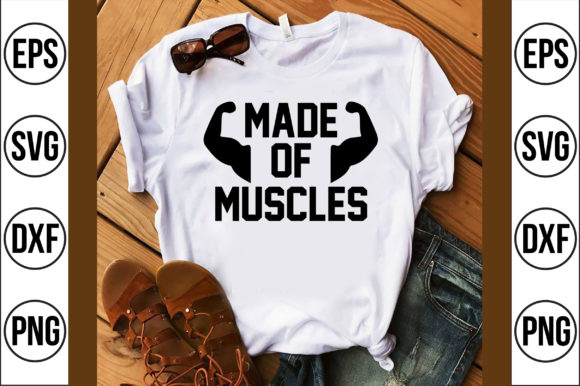
When I opened the Made of Muscles download and previewed the SVG and PNG files, my first thought wasn’t “cute” or “trendy”—it was “this will hold up.” The design has clean, confident outlines, balanced negative space, and a graphic weight that reads instantly—whether stitched on a soft cotton tote or a heavyweight sweatshirt. It’s not overly detailed, but it’s not minimalist either. There’s just enough contour and shading in the vector lines to suggest strength and character without relying on fine gradients or fragile linework. As a machine embroidery design, that balance is gold: it translates well into satin stitch for smooth edges and fill stitch for solid impact, especially at 3–4 inches wide.
A Real Project Test: Embroidering a Boutique Sweatshirt Line
Last week, I used Made of Muscles for a small-batch run of unisex crewneck sweatshirts—intended for a local maker pop-up. I chose midweight French terry, medium tear-away stabilizer, and matte polyester thread in charcoal and cream. The result? Crisp, dimensional stitching with zero puckering or thread breaks. The design’s compact shape (no long tails or sprawling elements) made hooping effortless—even on the curved shoulder seam. Customers responded immediately: one mom bought three for her kids’ sports team; another asked if we’d do a matching embroidered cap. That kind of organic engagement tells me Made of Muscles isn’t just visually strong—it carries personality that resonates in real life.
Where It Shines (and Where to Pause)
Made of Muscles excels on:
- Custom apparel: T-shirts, sweatshirts, and aprons—especially when you want bold, gender-neutral branding without cliché.
- Personalized gifts: Baby onesies (use lightweight cutaway stabilizer), pillow covers, and kitchen towels where legibility and charm matter more than photorealism.
- Small shop products: It scales cleanly from 2.5" patches to 5" chest designs, making it versatile for Etsy listings, craft fair merch, and boutique branding.
- Digital product previews: The included JPEG and PNG files render beautifully in printable mockups—no pixelation, no color bleed—so your online listings look professional before a single stitch is made.
But here’s where attention matters:
- Small hoop sizes: At under 2", fine muscle definition can blur. Test stitch at your smallest intended size—especially for baby embroidery or cap front placements.
- Textured or stretchy fabric: On slubbed linen or jersey, use cutaway + topping. The design’s solid areas benefit from extra support to prevent distortion.
- Dark or dense fabrics: The vector layout works well on black, but avoid ultra-heavy threads or high-density fills unless you’ve tested stitch density. Over-stuffing kills the clean graphic feel.
- Curved surfaces like caps: The centered, symmetrical composition helps—but always test on scrap cap fabric first. Some Cricut-compatible files assume flat placement, so verify alignment in your embroidery software.
Design Integrity Meets Commercial Practicality
As an embroidery designer who also sells digital design assets, I pay close attention to how a file supports both handmade presentation and brand consistency. Made of Muscles delivers on both. Its strong silhouette ensures recognition at a glance—critical for social media thumbnails, Etsy tags, and shelf appeal at craft fairs. More importantly, it doesn’t look “digital-first” and “embroidery-second.” The lines are generous enough for satin stitch legs, the curves are smooth (no jagged vector artifacts), and the spacing between elements avoids nesting issues in multi-color runs. That means fewer re-hoops, less thread waste, and faster turnaround—key for commercial embroidery or a growing craft business.
What You’ll Want to Check Before Stitching
Since this is a digital embroidery file—not a pre-digitized machine-ready motif—you’ll need to confirm a few things before your first run:
- Test on scrap fabric first, using your exact thread, stabilizer, and machine settings—not just the default software preview.
- Review stitch density in your embroidery software. If the fill areas look overly heavy or sparse, adjust density before stitching on final goods.
- Check hoop size compatibility. The SVG and DXF files give you flexibility, but your actual embroidery machine may require conversion—verify dimensions match your standard hoops.
- Inspect small details like knuckle contours or collar edges. Zoom in on the PNG and EPS files—if they’re pixelated or aliased, simplify in Illustrator before digitizing.
- Compare light vs. dark fabric backgrounds using the JPEG mockup. Does contrast hold? Does the design “pop” or disappear?
- Confirm licensing terms before selling finished products or reselling the digital file. This listing states “digital download only”—but commercial use rights aren’t specified, so verify before launching an Etsy shop line or wholesale offering.
Final Thought: Not Just a Graphic—A Reliable Design Asset
Made of Muscles isn’t flashy. It won’t win awards for complexity. But as a T-shirt design—and more broadly, as a graphics-driven embroidery file—it earns trust through reliability. It stitches cleanly across fabric types, scales without compromise, and carries enough visual wit to spark conversation without demanding explanation. For Etsy sellers building cohesive collections, for small shops adding embroidered accents to their lineup, or for hobbyists making personalized gifts that feel intentional and polished—Made of Muscles is the kind of design you return to, again and again, because it simply works. And in the real world of embroidery projects, that’s the highest compliment of all.